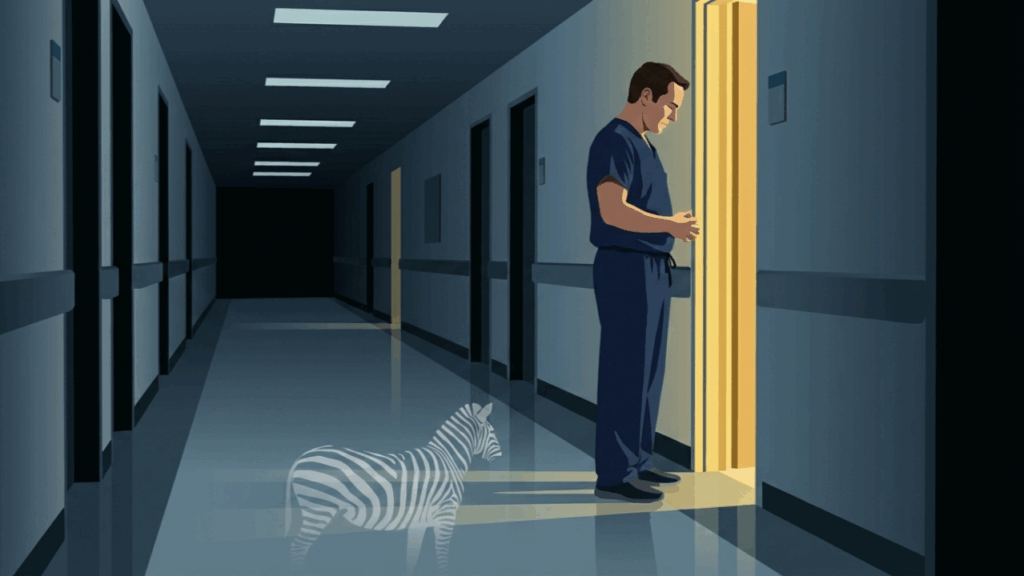
Every doctor learns the old saying early in training: “When you hear hoofbeats, think horses, not zebras.”
In other words, the simplest explanation is usually the right one.
Most of the time, that mindset saves lives. It keeps us efficient. It prevents overthinking. It helps us move fast in high-pressure environments where speed matters.
But every so often, a case refuses to follow the pattern.
In those moments, certainty becomes dangerous, while curiosity becomes the difference between recovery and tragedy.
This was one of those nights reminding me that medicine is not just science, but instinct.
Friday Night Lights
Friday night in Texas. High-school football.
A familiar rhythm during the season.
I was covering the game, nothing unusual. No catastrophic injuries. Just the standard collisions, cramps, and bruises that come with the sport.
At halftime, an athletic trainer pulled me aside.
The other team’s star wide receiver, the one who normally racks up catches, yards and touchdowns, had been hospitalized all week.
He couldn’t walk. The diagnosis was a hip strain.
A hip strain?
That didn’t sit right.
The athletic trainer and family asked me to come see him.
That night, after the game and seeing patients, I stopped by the hospital to see him.
It was close to midnight when I walked into his room.
He looked like a gladiator stuck in bed – strong, frustrated, and clearly in pain. He grimaced just trying to turn over.
No trauma history.
No fever.
No obvious red flags.
There was severe pain in the hip with almost any motion.
X-rays were normal.
MRI showed an apparent mild hip-flexor strain and a bulging lumbar disc on the opposite side of his pain.
On paper, it all looked reasonable.
The patient and his family were frustrated and scared. He’d scored 3 touchdowns in a game 1 week ago.
But none of it explained why an elite athlete couldn’t even roll over in bed. This an All-State contender who was needing a walker and 2 assistants to get to the bathroom.
He’d been in the hospital 5 days – with a hip strain.
When the Pattern Breaks
We needed to dig deeper. The horse was the strain. But, the zebra?
More labs.
A new MRI.
More questions.
By morning, the story changed.
The imaging showed inflammation far beyond what a strain could cause and new fluid collections. The lab work pointed toward infection – not only near the hip, but also in his bloodstream (bacteremia) which can lead to sepsis and death.
We started broad-spectrum antibiotics immediately and began asking the uncomfortable questions:
Any IV drug use?
Compromised immune system?
Recent travel, illness, intimate encounters?
The blood cultures came back.
MRSA. (Methicillin Resistant Staphylococcus Aureus)
A dangerous, aggressive bacteria, eating away at his sacroiliac joint.
Infectious disease specialists tailored the antibiotics.
Interventional radiology drained the infection.
Within days, he was walking with a cane.
Within a week, he was home starting a long course of IV antibiotics.
His family called it life-saving.
They were right.
Untreated, that infection could have been fatal.
He’s since recovered – walking, running, lifting weights and planning his future.
The Trap of Pattern Dependence
Medicine trains you to recognize patterns quickly.
Experience teaches you not to depend on them blindly.
Pattern recognition keeps us efficient.
Pattern dependence blinds us to anomalies.
The best clinicians, and the best leaders, learn to live in the tension between the two.
That night, I was looking for horses.
But when none appeared, curiosity forced me to consider the zebra.
The Zebra Rule
The Zebra Rule: Trust the pattern, but never turn off your curiosity.
Curiosity is what keeps experts from becoming complacent.
It’s what allows you to notice what doesn’t fit, in a patient chart, a project timeline, or a business strategy.
The moment you assume you’ve seen it all, you stop seeing what’s right in front of you.
Why This Matters Beyond Medicine
In leadership, diagnostics, and daily decision-making, the Zebra Rule holds up remarkably well.
When something doesn’t make sense, slow down instead of doubling down.
When data conflicts with intuition, investigate both.
When the “obvious” answer feels too neat, ask one more question.
That extra moment of curiosity can save a life.
Or a deal.
Or a team.
Or months of heading confidently in the wrong direction.
The Part That Stays With Me
The patient recovered fully.
I still think about that night whenever something doesn’t quite add up.
Horses are common.
Zebras are rare.
But you’ll never find one if you stop looking.
And in the moments that matter most, curiosity isn’t a distraction from expertise.
It’s what makes expertise work.